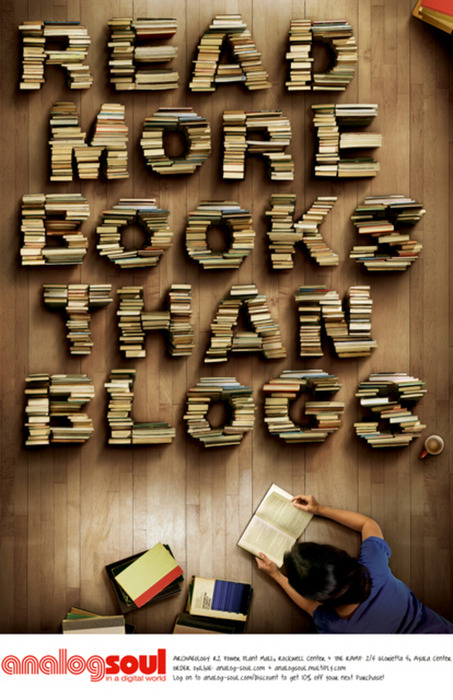
I have been doing quite a bit of abstract thinking that may or may not form itself into a post. It involves capitalism, and the television show "
Hoarders," and our culture of consumption, and
Fahrenheit 451 (which I'm only now reading for the first time - I know, I know), and the future of books. There are many strands floating around that may or may not coalesce.
For now, I was interested to see
today's article by Julie Bosman in the NY Times on e-books made for use on the iPad. Bosman covers new products, though publishers have not universally settled on a new term for such products:
In the spring Hachette Book Group called its version, by David Baldacci, an “enriched” book. Penguin Group released an “amplified” version of a novel by Ken Follett last week. And on Thursday Simon & Schuster will come out with one of its own, an “enhanced” e-book version of “Nixonland” by Rick Perlstein.
Now I have to confess that my sister now has an iPad. Her husband bought her one for their anniversary, calling me first to discuss. I did not steer him away from it and even talked about some of the positive features. I guess some part of me wanted someone close to me to buy it, play with it, and report back. She opened the gift last weekend and we talked about it on Monday. I told her how I sat next to a man on a plane from Houston to Boston who sat quietly flipping "pages" for the entire flight, his attention rapt. Near the end of the flight, he flipped the thing over and worked on some PowerPoint presentation. I also mentioned the article I linked to in
my last post. I also emailed her information about the
Dr. Seuss products available for the iPad - adapted from the books, for my six year old nephew. (It turns out he doesn't like Dr. Seuss, which may be insane, offensive, or awesome - I haven't decided.)
I chatted with her today and she said she's enjoying the iPad, but her experience does give one insight into its uses by someone who is not typically considered an early adopter of anything. They went through a ton of Youtube clips, some of which she said were hilarious but others of which confused her, in that they were painfully boring and tedious and yet highly rated and commented upon. Such is the world of the new, unedited media, hm? Thanks, crowd-sourcing!
But we also talked about this article, which I had just read, and about publishers embedding videos into e-books, and we agreed that those were two different parts of one's brain that would be competing. "Either I'm watching a video or I'm reading a book. I don't want both." She suggested maybe our brains are just trained that way because we have read so many books, and maybe younger people would find videos in books a lot more appealing.
In reading this piece, I see that Bosman mentions how,
Grand Central Publishing, part of Hachette, released an “enriched” e-book version of Mr. Baldacci’s latest novel, “Deliver Us From Evil,” in April to coincide with the hardcover release. The e-book producers borrowed from the film industry and included “research photos taken by the author, deleted scenes from the manuscript, an alternate ending and other special features,” Hachette announced in March.
When I read that, I thought about how I do look to see if a dvd has "extras" when I'm thinking of buying it, even though I rarely sit and watch director's cuts, or commentary (except on John Waters' movies, which are always good). Are we now going to raise the bar with books, and demand that an author writing a narrative isn't enough? "Oh, her novel doesn't have a trailer, and 'writing-of' segment, a series of photos so I know what to imagine for various scenes? Forget it!"
I don't know, though. I admitted to my sister that I do go online to see author websites sometimes, and I have been known to read a Q&A with the author at the back of a
Harper Perennial paperback. It does make one wonder if this is the way the publishing industry is going to change, by adding capacity by seeking out employees who can think up and create these extras. That would still be a creative enterprise in service to the author's work.
But this is all iPad related. We've all heard about companies coming forward to do this kind of work but they've been given a bigger market as the iPad has rolled out. As Bosman quotes in teh article,
Brad Inman, chief executive of Vook, said his company is working with 25 publishers to create multimedia books. “The iPad brought this to life,” he said. “Everyone knows now that they’ve got to put their toe in this water.”
So... where does this leave other readers, most especially the biggest and loudest of them all, the Kindle? Well, Bezos is now announcing a cheaper version, a "mass market" type of deal. As Geoffrey Fowler
reports in the WSJ,
The new Kindle features a screen with increased gray-scale contrast, a battery that lasts for a month, and a slightly smaller size. It will come in two flavors: one with Wi-Fi and 3G Internet connections selling for $189, the other with Wi-Fi only for $139. The latter will be among the cheapest wireless-equipped e-readers on the market, at least for now.
Hm. Too little, too late? And everything Bezos says sounds sleazy. His quote here, "People will buy them for their kids. People won't share Kindles any more." It's like he's not sophisticated enough to code language so it's not quite so desperate.
But then, in explaining why the Kindle doesn't have the bells and whistles of a table like the iPad.... oh I hate to say this... Bezos makes my same point!
"For the vast majority of books, adding video and animation is not going to be helpful. It is distracting rather than enhancing. You are not going to improve Hemingway by adding video snippets," he said.
Oh God that smarts.
As Christopher and I have both said, at some point, I just think these guys are trying to tell me I want, or even need something that I really don't. You know what? When I watch a good movie, I don't need extras. And when I want to read a book, I don't need something electronic. I just need to grab something made largely of paper and open it, and sometimes stuff it in my bag or under my arm, and take it on a train or plane or on a walk. (My sister pointed out, "I'm not sticking this thing in my beach bag, that's for sure.") These stories fill the "pages" of our newspapers, but at some point, is it a bunch of noise about nothing?
I mean that on a happy note, but in case you're not happy yet:
Thanks to Adele Enerson at
Mila'sDaydreams for this ridiculously cute "bookworm."
[PS I would be grateful if anyone in North Carolina, in particular Wilmington, can tell me why
this post on the Kindle debates from last May keeps getting hits from your region. Any clues? Thanks!]